Use of Calcium in the
Rubber Industry
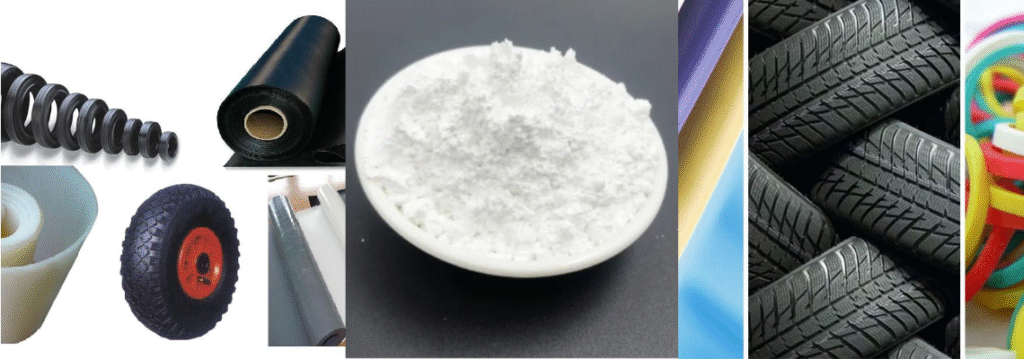
Calcium, primarily in the form of Calcium Carbonate (CaCO₃), is a widely used filler, extender, and processing aid in the rubber industry. It helps enhance the strength, flexibility, processability, surface finish, and cost-effectiveness of rubber products. With its availability, whiteness, chemical stability, and controlled particle size, calcium is ideal for applications such as tires, hoses, belts, sheets, gaskets, footwear, and other molded rubber components.
Why Calcium is Used in Rubber Manufacturing
Cost-Effective Filler
Reduces the use of expensive raw materials while maintaining product performance and lowering production costs.
Improves Strength and Flexibility
Enhances tear resistance, tensile strength, and elasticity for better performance.
Enhances Surface Smoothness
Provides a finer texture and improved appearance for better functionality and aesthetics.
Improves Processability
Ensures uniform mixing, easier extrusion, and efficient molding during production.
Provides Thermal and Chemical Stability
Protects rubber products from degradation due to heat, chemicals, or environmental conditions.
Ensures Dimensional Stability
Reduces shrinkage, cracking, and deformation during processing and use.
Supports Environmentally Friendly Production
Being a naturally occurring mineral, calcium supports sustainable and energy-efficient manufacturing.
Applications of Calcium in the Rubber Industry
Tires and Tubes
Enhances abrasion resistance, durability, and performance
Provides structural strength under pressure and heat
Hoses, Belts, and Seals
Improves flexibility, wear resistance, and lifespan
Protects against oils, chemicals, and moisture
Footwear, Gaskets, and Molded Products
Enhances surface quality, aesthetics, and durability
Provides resistance against cracking and wear
Industrial Rubber Products
Used in sheets, pads, covers, and rollers
Supports mechanical strength and stability under harsh conditions
Benefits of Using Calcium in Rubber
Conclusion
Calcium, especially in the form of calcium carbonate, is a vital component in the rubber industry. It contributes to cost savings, improved strength, flexibility, surface finish, and processability while ensuring dimensional stability and environmental protection. From tires and hoses to footwear and industrial sheets, calcium enhances product performance and reliability in diverse applications. Its natural abundance and eco-friendly profile make it a sustainable and efficient choice for modern rubber manufacturing.

 Reduces material and production costs